



Drilling Fluid Solids Control Equipment – A Practical Selection Guide
In oil & gas drilling and horizontal directional drilling (HDD), drilling fluid is often called the “blood of the wellbore.” The main job of solids control equipment is to separate drilled cuttings, sand, and fine solids from the mud so the cleaned fluid can be re‑used.
Field engineers run into the same problems time and again: screen blinding on the shale shaker, underflow blockage on the desander, or a centrifuge discharging wet solids. More often than not, these problems are not equipment defects – they come from poor system configuration or wrong operating parameters.
Below is a stage‑by‑stage look at the four levels of a typical mud solids control equipment setup, along with selection tips and real‑world fixes.
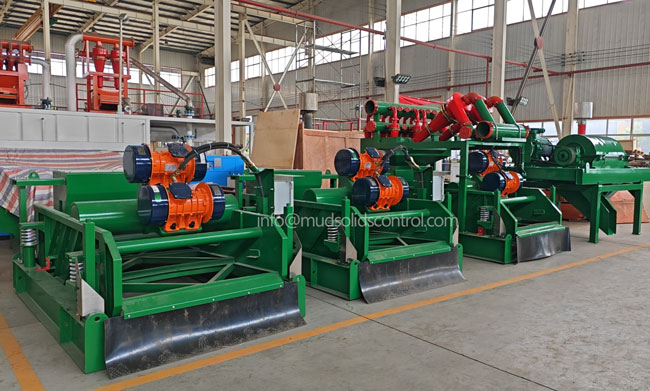
1. Shale Shaker – The First Door
The shale shaker handles the largest volume of all solid control equipment. It uses high‑frequency vibration and screen meshes to remove coarse cuttings larger than the screen opening.
Three parameters really matter when selecting shale shaker: vibration pattern, screen area, and excitation force. Linear motion works for high‑rate deep drilling; elliptical motion performs better in sticky clay formations. Screen area directly sets throughput – if the area is one size too small, you double the risk of mud loss over the screens.
A common mistake: swapping 80‑mesh screens for 40‑mesh to push more mud through. That overloads the downstream desander and centrifuge, and the centrifuge bowl wears out much faster.
2. Desander & Desilter – Hydrocyclone Separation
After the shaker, remaining fine solids go to the desander and desilter. Both work on the same principle – centrifugal force throws heavier solids to the cyclone wall and down through the underflow, while cleaned liquid exits through the overflow.
The difference is the cut point: a desander typically removes particles above 40 microns; a desilter handles the 15–40 micron range. A single 10‑inch desander cyclone processes roughly 120–150 m³/h. If you swap to a 4‑inch desilter cyclone, the capacity drops to 30–40 m³/h per unit.
On site, a solid, slightly umbrella‑shaped underflow discharge means feed pressure is right. If the underflow sputters or stops completely, either the apex nozzle is worn or the feed pump doesn’t deliver enough head.
3. Decanter Centrifuge – Final Fine‑Cut Separation
The centrifuge is the most precise – and most finicky – part of any drilling fluid cleaning system. A rotating bowl and a screw conveyor (scroll) run at different speeds to spin out ultra‑fine solids down to 2–5 microns, which are then pushed to the discharge ports.
A key trade‑off: higher bowl speed gives better separation, but large‑diameter bowls running at high speed wear out bearings and seals much faster. For high‑volume bulk processing, choose a bowl diameter of 450 mm or larger. For lower‑flow applications like recovering barite from weighted mud, a 220–350 mm unit works fine.
Differential speed (the rpm difference between bowl and scroll) is often set wrong in the field. Too high a differential, and solids don’t have time to settle – the discharge liquid stays cloudy. Too low a differential, and the scroll doesn’t push solids out fast enough – the cake builds up and eventually locks the bowl. As a rule of thumb: for polymer muds, keep differential at 5–8 rpm; for weighted muds, drop it to 1–3 rpm.
4. Common Configuration Mistakes in a Full Solids Control System
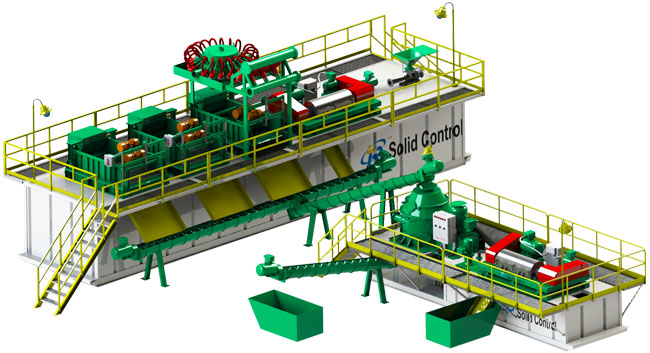
A standard four‑stage drilling fluid solids control equipment train goes: shaker → desander → desilter → centrifuge. In practice, many rigs keep the centrifuge as a “standby” unit – they only turn it on when solids build up to a critical level. That works for shallow sections, but once you go deeper or start a horizontal leg, fine solids keep accumulating. That leads to higher filtrate loss, a thick and slick filter cake, and eventually differential sticking.
Another detail often overlooked: keep the centrifuge solids discharge away from the shaker feed trough. If the dried cuttings (or barite recovery solids) fall right back onto the shaker screen, you are simply re‑circulating them for no reason.
5. Practical Selection Tips
Match the equipment to your typical mud system. High‑viscosity polymer muds need shaker screens with better flow capacity. Oil‑based muds require explosion‑proof electrical panels and oil‑resistant seals.
Stock enough screens and cyclone apexes. Most screen changes on site happen not because the screen is torn, but because the mesh size is not suitable for the current formation – this is far more common than people admit.
Do not run the centrifuge only “when trouble hits”. A regular centrifuge sweep run (say once per tour) removes ultrafine solids from the bottom of the active tanks. That alone can extend the service life of the whole circulating system.
A well‑sized mud solids control equipment package can increase re‑use of each cubic meter of mud by three to five times, while cutting disposal costs for drilled solids by more than half. Money saved by skimping on equipment rarely covers the extra mud spend and environmental fees later.